
Parallel World - Part 2
A marriage, seen from another side. Silence, once chosen, begins to fracture. What is spoken reveals a different world. And tolerance slowly disappears.

If you’d like to begin from the first chapter, Parallel World – Part 1 is here.
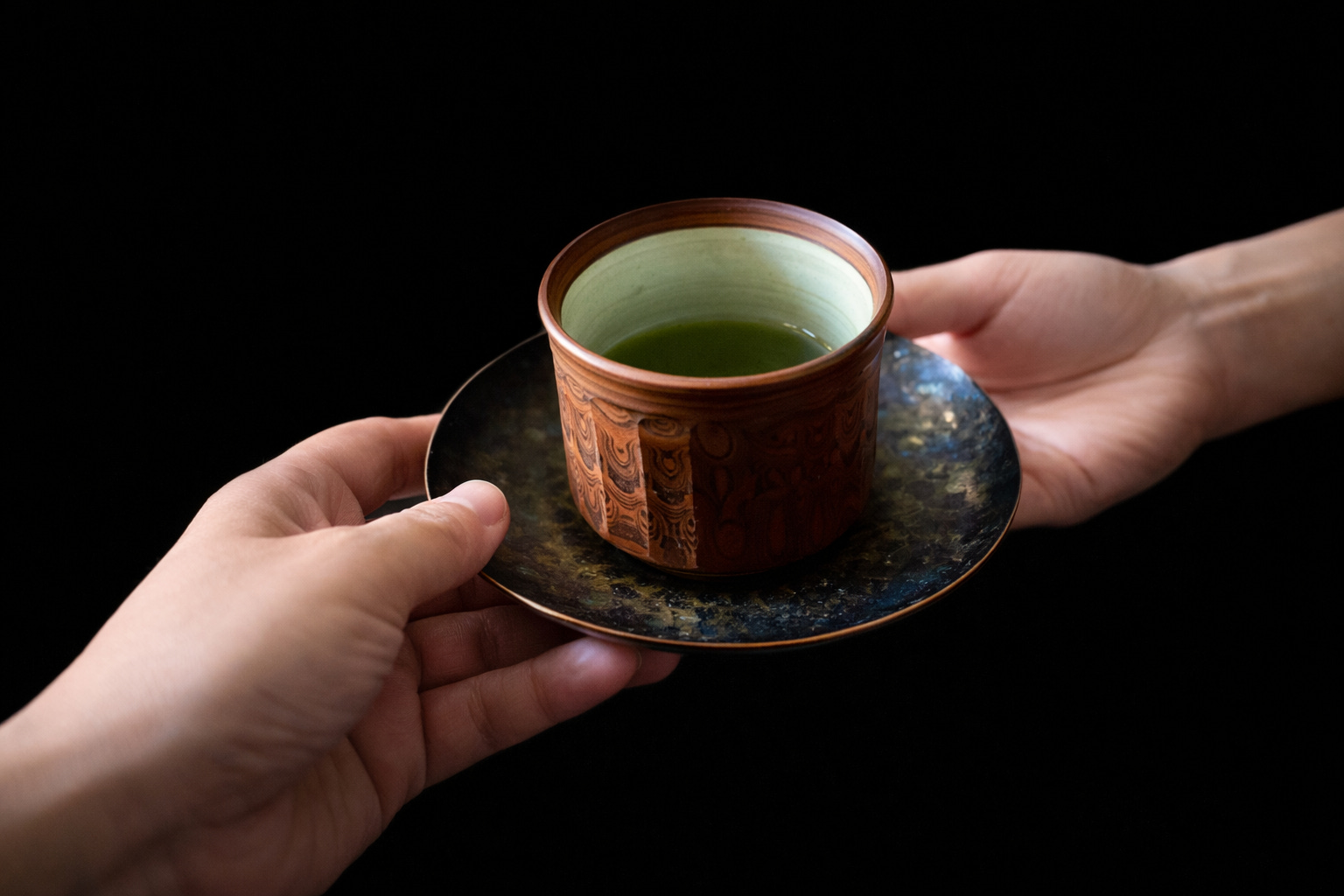
The elderly mediator offered my husband a cup of tea.
I drew a slow breath and entrusted myself to the art of silence. (This chapter stands on the quiet ground of The Art of Silence, written earlier. You can read it here if you wish.)
I inhaled, then closed my mouth. That alone allowed my emotions to disperse gently throughout my entire body.
I closed my eyes.
The feelings that rose within me took the shape of someone who had once taught me that, in moments of consequence, silence can be a form of dignity.
I bowed deeply to the figure that appeared behind my eyelids.
“Thank you.”
Keeping my head lowered, I opened my eyes.
A fourteen-karat gold ring caught my attention.
My hands, resting loosely on the table, looked like decorative ornaments, the gold standing out with quiet insistence. My left hand was gripping my right, though I had not been aware of it.
On the ring finger was a design of two intertwined golden strands, inspired by Celtic patterns. I remembered why I loved it.
I had designed it myself.
There were only two such rings in the world.
I shifted my awareness to the hand beside me. It was restless. With every movement, his tension filled the room. There was no matching ring on his finger.
I remembered then.
The other ring had disappeared years ago.
Which meant that the one before me was now the only one left in existence.
Suddenly, the ring felt precious.

Beyond it, I glimpsed the bluebird at the centre of my pale-blue notebook. My gaze rested on neither, drifting somewhere in between. And strangely, I felt protected, as if the tension flowing from beside me were being gently repelled.
When you can no longer keep silence, remove the ring.
This ring exists for that purpose.
It felt like a voice, or perhaps a breeze. I lifted my head.
The mediator was staring at me, visibly surprised.
At once, English reached me from the opposite side of the table. The interpreter had begun to speak.
The words entered through my left ear, stirring my mind. I allowed my imagination to work, attempting to observe—the marriage being described —objectively.
What I heard was shocking.
DO ALL THINGS WITH LOVE.
I opened the pale-blue notebook and read the words once more. I closed my eyes, steadied myself, and listened again.
A completely different marriage existed there.
What, exactly, was he talking about?
Was my imagination too vivid?
I felt the urge to interrupt. But the host of this tea gathering had not yet offered me the next cup.
To take another’s tea without invitation would be unthinkable.
The interpreter gave my husband a signal to continue. He resumed speaking.
How much more could there be?
In desperation, I raised my left hand to my mouth, trying to silence myself physically. At that moment, the gold ring seemed to glint. I swallowed and slowly moved my right hand.
I remembered the whisper.
Pressing my thumb, middle finger, and ring finger together, I felt the engraved pattern beneath my skin. I slid the ring off.
Instantly, my husband’s voice receded, as if pulled into the distance. The space around me warped. The bluebird appeared again, and beyond it, a garden filled with white hydrangeas bloomed across the pages of the blue notebook.
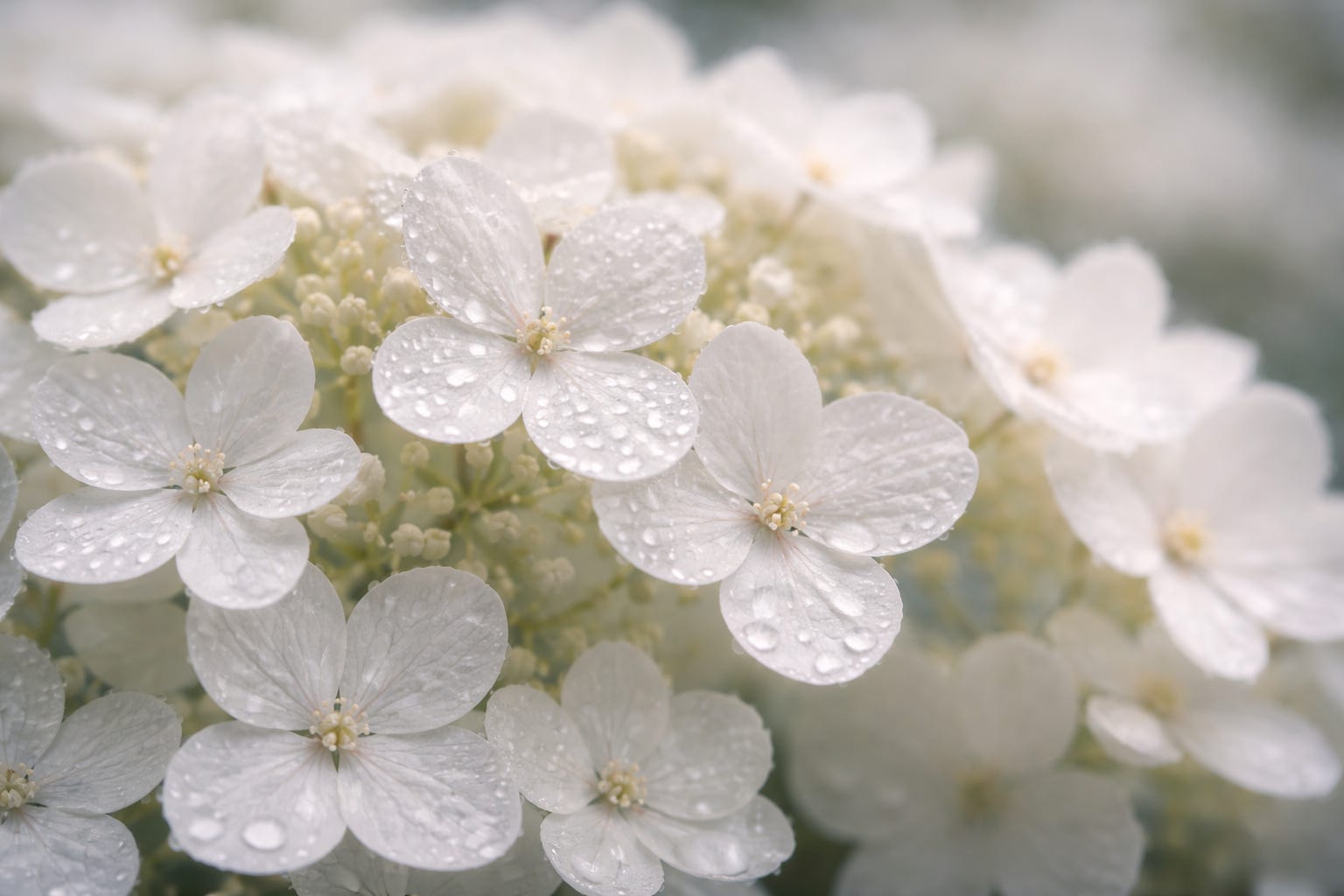
White hydrangeas.
Their language is tolerance.
The sound of my husband’s voice changed—hard, oppressive, like stone. The hydrangeas trembled. I no longer needed to understand his words; the vibration alone told me what he was saying.
The marriage he described, filtered through his senses, shared no resonance with the one I had spoken of.
English flowed again through my left ear.
Standing in the garden of hydrangeas, I felt as though I had stepped into the marriage he was describing. Each day was saturated with tension. The tension spread, and one by one, the flowers withered. A shadow passed over the sun. I stood at the centre of it all.
In his account, he was the complete victim.
Surrounded by dead blossoms, I listened as his version of our marriage poured in through my left ear.
The cause, he said, was me.
He made no mention of the year and a half he did not work.
Nor of the household tasks he never shared.
Nor of the alcohol he drank at home.
What he spoke of was my failure to be perfect.
“This isn’t true.”
I tried to speak, but no sound came.
Of course. I had removed the ring.
He emphasised the floors I had not cleaned, exaggerating until it felt as though he were describing an entirely different reality.
Words clogged my throat. Excuses swirled, but none became sound.
A single dried hydrangea petal was lifted by the wind and struck my face.
Slowly, it fell to the ground. Beneath it lay white sand, raked into wave-like patterns, just like the garden I had once seen in Rikyū’s world.
The garden where my withered tolerance had fallen was strangely beautiful.
He complained that my voice during online work made the house feel stressful.
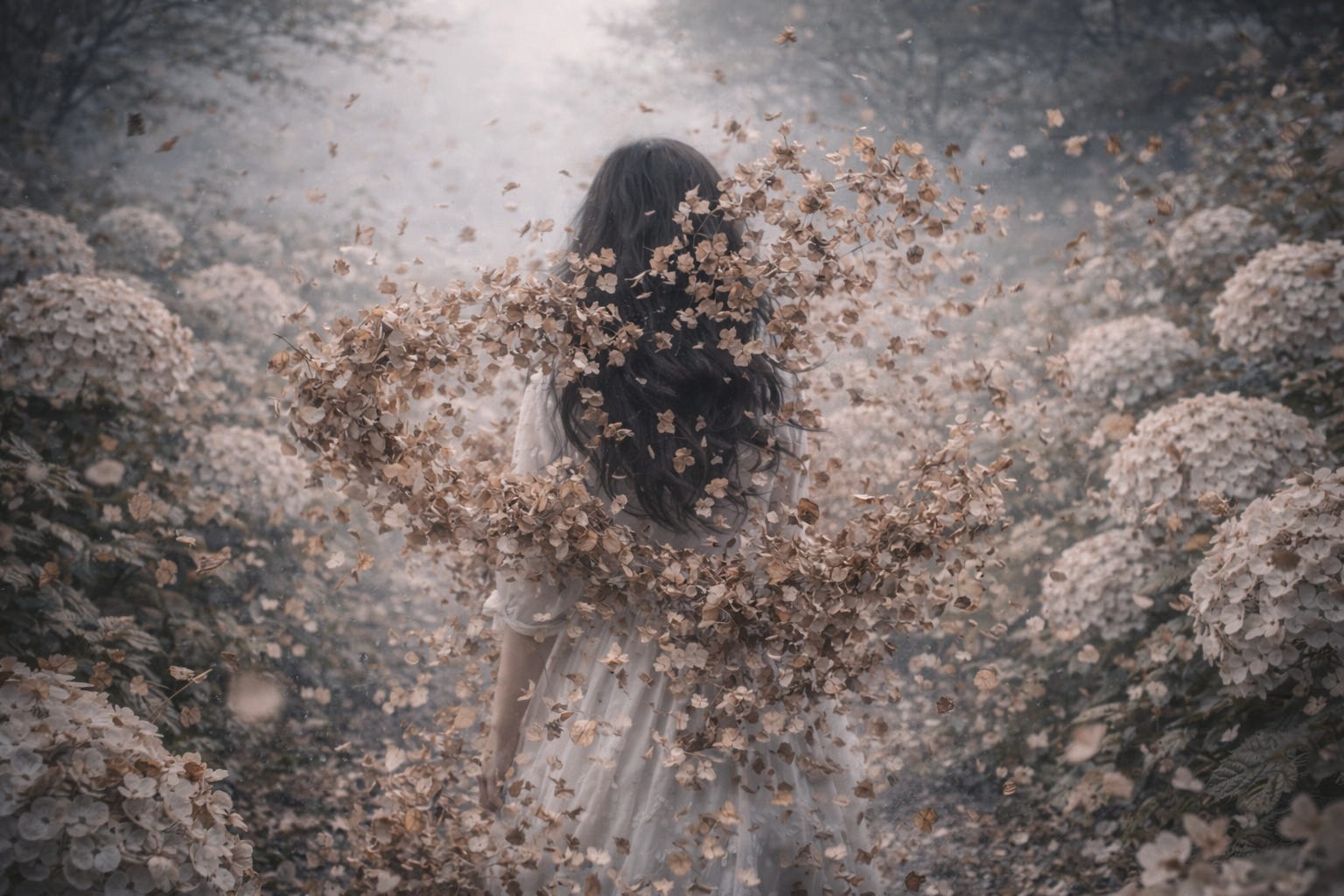
Each exaggeration sent more dead petals spiralling into the air, forming a small storm around me. My tolerance, reduced to petal after petal, wrapped itself around my body.
Then the storm stopped.
As my vision cleared, I saw it.
Beneath the petals covering the white sand lay the answer.
Everything was “my responsibility.”
His words struck without warning.
“I had no choice but to open a beer because of the stress of spending less time with my wife.”
Buried beneath the dead petals, I could no longer tell where my feet were. When I looked around, not a single flower of tolerance remained inside me.
To be continued to 1.18. Parallel World - Part 3

Afterword
This piece is dedicated to the day itself:
December 21, 2025.
The longest night of the year.
The day most willing to meet the dark.
On this day, I was able to face the deepest shadow held in my emotional memory honestly, without turning away,
and to let it go.
I wrote with one simple discipline in mind:
to speak without lying,
without over-explaining,
without justification,
without attack.
What surprised me was not the memory,
but how it changed when filtered this way.
Less sharp.
More transparent.
And, somehow, more beautiful.
I feel a quiet relief knowing this chapter could finally take the form it had been waiting for.
If something in it resonates with you, that is enough.
Part Three will move closer to the core.
Thank you, always, for giving your time, your attention, and your silence to these words.
With gratitude,
Yuko